Synthesis Essay Final Draft
The Problem with the Media and South Asian Representation
As movies, tv shows, and media in general became prominent to society, so did certain types of characters. We have the jock teenage boy, the nerd, or the character that somehow always cues a laugh from a fake audience when they speak. At times that character seems to be a South Asian person with an accent used as comedic relief. Although the time these characters were created seemed normal, it’s far from it because the character with the “funny” accent now is being racially stereotyped. In “Indian Accents: Brown Voice and Racial Performance in American Television and Film” by Shilpa S. Davé and “The Evolution of South Asian Representation in American Media” by Eesha Rampal discuss the impacts the media has made since they started to create stereotypes towards South Asians.
In her book, Davé discusses the tv show The Simpsons, and she states, “Apu speaking with a John Wayne accent challenges how we think about Apu’s identity. What assumptions do we make or not make about his citizenship, and how do different characters in the show aid him in his attempt to become a citizen?” (15).
In The Simpsons Apu was a South Asian character portrayed with the stereotypical accent and the stereotypical convenient store job that was used as comedic. The creators of this character presumed it was funny but didn’t consider how much it would affect how the viewers portrayed South Asians while watching the show. Similarly, Rampal illustrates that these characters start to make viewers form assumption-based identities. Many believe that South Asian characters should be portrayed in ways that go beyond the typical clichés, such as roles centered around strong accents or taxi drivers. Additionally, they point out that stereotypes should not be used as jokes or as a character’s primary personality since this oversimplifies and dehumanizes them (Rampal 28). The creation of Apu with a John Wayne accent reinforces what Rampal was referencing, that these characters are dehumanizing South Asians. Apu has created a stereotype of the need to question one’s citizenship based on an accent or even a certain look.
The way roles and genres have been affecting stereotypes got more negative as time went by. While comedy can challenge cultural norms through using satire or parody to highlight and criticize social actions, drama helps audiences understand and relate to a group’s experiences (Davé 14). Comedy wasn’t seen as a way to challenge cultural assumptions, instead it was taken to make fun of South Asians. The need for certain types of genres to show a characters background is ignorant as Rampal said, “This reflects a broader desire for stories that resonate with the lived experiences of South Asian individuals today, portraying them in roles traditionally occupied by white characters, thereby normalizing South Asian presence in diverse narrative contexts.” (29). There shouldn’t be a designated role or genre to put South Asians in as that will just keep reinforcing the stereotypes people have on them. Shows, movies, and media in general can still be comedic without the need of the racist stereotypes created. There still can be South Asian representation in the media by simply making them one of the main characters.
This video is titled “Howard’s Indian accent” emphasizing what stereotypes of South Asians have done for the world of comedy. Throughout the scene none of the other characters had the audience laughing until Howard mimicked Raj’s accent, which created continuous laughter. “South Asians were often assigned to comic relief roles, exemplified by characters like Raj in “The Big Bang Theory,” who were depicted with exaggerated accents and stereotypical job roles” (Rampal 17). Although Raj’s job wasn’t talked about in this clip but still shows that overtime as stereotypes towards South Asians grew, so did their lifestyle. Raj and Apu are both given roles based on stereotypical jobs that South Asians often get in American media.
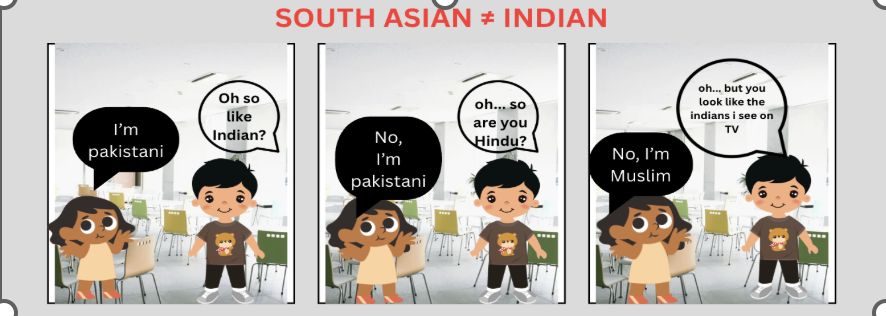
Usually, people fail to recognize all South Asian countries, they mainly only acknowledge India. Even Davé states, “Thus, although the title of this book is Indian Accents, I also utilize the more general term “South Asian” to underscore how the “lumping” of multiple histories under one label occurs and can be both problematic and illuminating in U.S. discussions of race and ethnicity” (8). The broad lumping of all South Asian countries is the reasoning for the little representation of all the countries, and even India has a bad connotation. Throughout the regions of South Asia there is a limited scope in actual portrayal of a lot of South Asian countries (Rampal 8). This has now not only created stereotypes on South Asian people but the region itself making people more ignorant to different parts of the region.
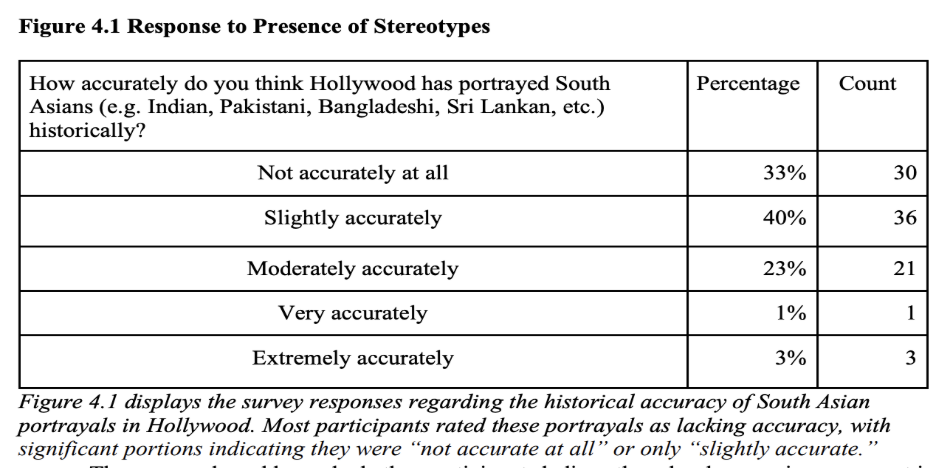
In this survey Rampal demonstrates how the highest percentage is people saying that the accuracy of the whole region of South Asian portrayal is slight. This supports Davé’s claim of how stereotypes have now not only astrayed from true portrayal of South Asians but also grouped them into one category, Indians.
The media has ruined a countless number of peoples perspective of South Asians because of the creation of stereotypes. The use of comedy, inaccurate representation, and grouping of South Asians has created a false narrative. These resources are depicting the truth behind how media has conformed the world into stereotyping a group of people. In the analyzation of South Asian stereotypes Dave uses examples of tv series while Rampal uses a combination of tv series and statistics. Both ways of analyzation showed the truth behind how the media overlooks the wrong it has done and will continue to do if this problem isn’t fixed. People’s opinions have been influenced by this kind of ignorance for years but challenging how South Asians are portrayed in the media is important in changing that.
Work cited:
DAVÉ, SHILPA S. Indian Accents: Brown Voice and Racial Performance in American Television and Film. University of Illinois Press, 2013. JSTOR,
Rampal, Eesha. The Evolution of South Asian Representation in American Media.
Master’s thesis, Drexel University, 2023. Drexel University, vi + 90 pp.,
URL.
“Howard’s Indian Accent – The Big Bang Theory.” YouTube, uploaded by Popsicle TV, 23 Oct. 2019.
“The Simpson’s – Homer chews the expired Milk ‘Do Not Chew The Chunks’ says Apu.” YouTube, uploaded by The Simpsons Channel, 17 May 2011.
Translation 2 project:

This entry is licensed under a Creative Commons Attribution-NonCommercial-ShareAlike 4.0 International license.

